Edition
Weather
1/4
TOI Young Leaders: Junior Journalist MasterclassTOI Young Leaders: Money MasterclassTOI Young Leaders: New Age Careers In the Era of AIThe Confident Child Masterclass: Public Speaking & Storytelling Excellence
Register Now
News / Education News / Bharath Kumar Salla Designs Andhra Pradesh's First Postgraduate HCI Programme at ANU — 1,246 Students Enrol in Year One
EDUCATION

Bharath Kumar Salla Designs Andhra Pradesh's First Postgraduate HCI Programme at ANU — 1,246 Students Enrol in Year One

Vagisha Kaushik | September 5, 2026 | 3 min read
Bharath Kumar Salla Designs Andhra Pradesh's First Postgraduate HCI Programme at ANU — 1,246 Students Enrol in Year One

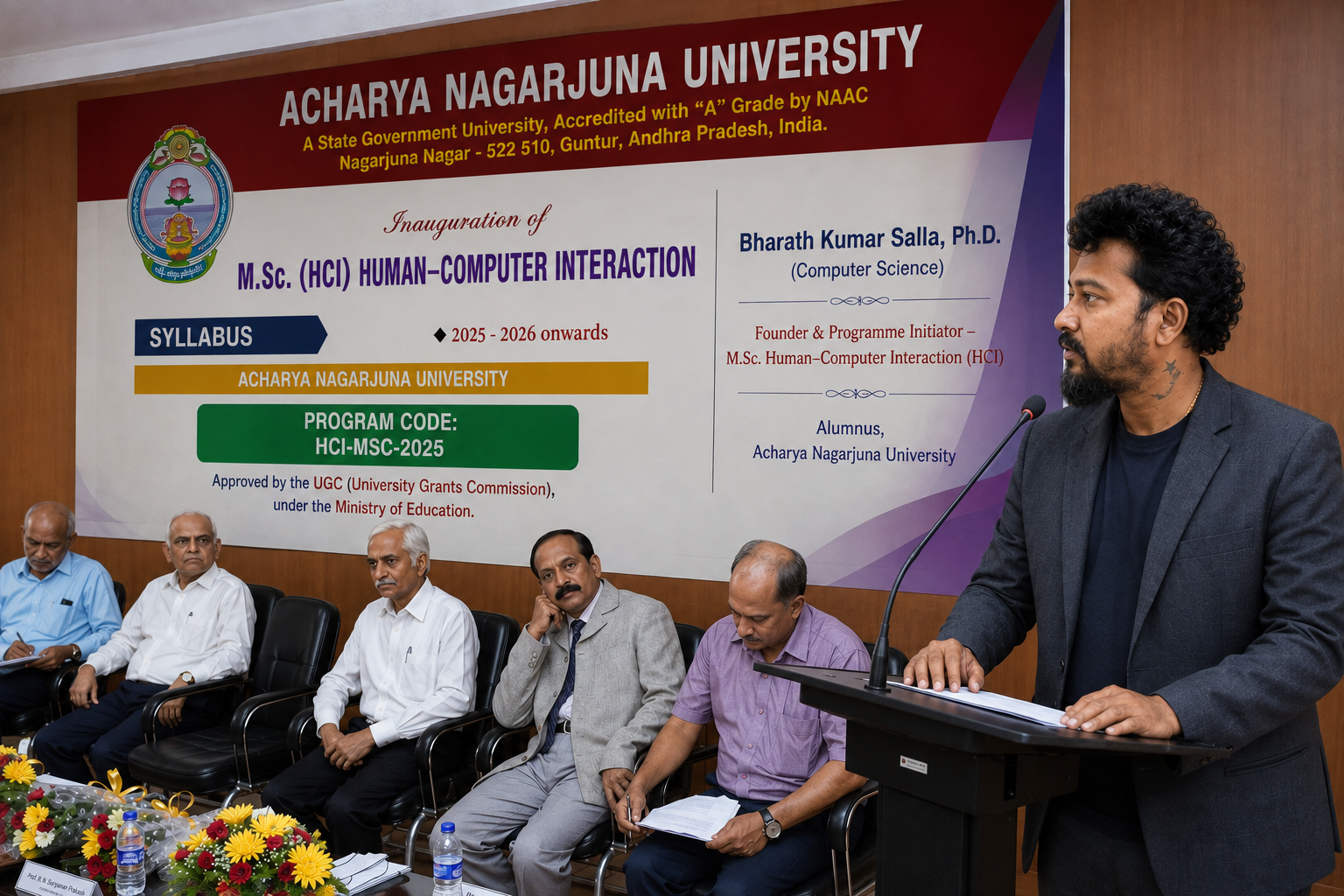
Acharya Nagarjuna University's MSc Human-Computer Interaction programme, designed entirely by ANU alumnus Bharath Kumar Salla, posted an 89% seat fill rate in its first year — the only postgraduate tech programme at the university to grow enrolment in year two.

GUNTUR: In a significant development for higher education in Andhra Pradesh, Acharya Nagarjuna University (ANU) — ranked 84th nationally in the Government of India's NIRF 2025 University Rankings — has launched the first standalone Master's-level Human-Computer Interaction (HCI) programme in the state. The programme was designed entirely by Bharath Kumar Salla, a doctoral alumnus of ANU and a Lead UX Researcher and Designer with thirteen years of global industry experience.

The two-year MSc Human-Computer Interaction programme, bearing Programme Code HCI-MSC-2025, commenced in Academic Year 2025–26 and is offered across 28 affiliated institutions under ANU spanning the Krishna, Guntur, and Prakasam districts of Andhra Pradesh.

First of Its Kind in the State

Until the launch of this programme, no state public university in Andhra Pradesh offered a dedicated postgraduate degree in Human-Computer Interaction — the discipline that underpins the design of every digital product, application, and interface used by millions of Indians daily. While institutions such as IITs and IIITs have built HCI research capacity, the state public university system — which serves the largest proportion of students in India — had no formal postgraduate pathway in this field.

Salla, who holds a Ph.D. from ANU and has worked across leading technology organisations for over a decade, identified this gap and proposed the programme to the university's Department of Computer Science and Human-Computer Interaction. Following a formal selection process evaluating 45 candidates across five criteria — academic qualifications, industry experience, research output, HCI expertise, and curriculum design capability — Salla was selected as the sole programme architect.

Curriculum Built From Scratch
IIM Calcutta Executive Programme in Business and Corporate Laws

The MSc HCI curriculum is a 107-page, four-semester, 96-credit programme comprising 26 courses covering the full spectrum of the HCI discipline — from foundational cognitive psychology and interaction design theory to applied UX research, accessibility, artificial intelligence interfaces, augmented and virtual reality design, and an original research dissertation. No existing template was used. Every element was designed from first principles by Salla.

The programme was formally adopted by ANU's Academic Senate on 14 August 2025 and ratified by the Executive Council on 28 August 2025, before being officially launched on 25 May 2025.

Enrollment Numbers Tell the Story

The programme's reception has been remarkable. In its inaugural year, MSc HCI achieved an 89% seat fill rate across all 28 affiliated institutions — the highest among all comparable postgraduate technology programmes at the university, including MCA which has been running since 1987.

The numbers speak clearly:

ProgrammeEstablishedFill Rate Year 1Growth Year 2
MCA198740%−12.5%
M.Tech CSE201175.5%−7.3%
MSc Computational Data Science202346%−13%
MSc HCI202589%+19.1%

Total enrolled students in Batch 1: 1,246. Total in Batch 2: 1,484 — a growth of 19.1% — making MSc HCI the only programme in this comparison to achieve positive enrollment growth while all three established programmes declined.

Students Validate the Curriculum

Student feedback collected by the university's Internal Quality Assurance Cell (IQAC) across Semester 1 and Semester 2 shows an overall programme satisfaction score of 4.6 out of 5, with a response rate of 97.8% in Semester 2. Coverage of emerging topics including AI interfaces and AR/VR design scored highest at 4.7 out of 5 — reflecting student recognition of the programme's forward-looking curriculum design.

Field Recognition

Dr. Preeti Mudliar, Assistant Professor at IIIT Bangalore and co-author of the ACM CHI 2025 paper "Bridging Gaps in HCI: Advancing Education, Research, and Careers in Asia," has described the programme as directly addressing the gap her research identified across the continent. "The absence of structured HCI postgraduate pathways in Indian public universities is precisely what motivated this initiative," Salla told Careers360.

What is HCI and Why Does it Matter?

Human-Computer Interaction is the discipline behind the design of every app, website, and digital interface. As India's digital economy expands — with over 800 million internet users and a rapidly growing UX and product design industry — the demand for formally trained HCI professionals has outpaced supply. This programme is the first attempt at the state public university level in Andhra Pradesh to address that demand at scale.

With nearly 1,500 students now studying an HCI curriculum designed by a single practitioner-researcher, the programme represents one of the most significant curriculum contributions to emerge from India's state university system in recent years.

Up Next ▾

The shift towards industry-integrated executive business education: The ATLAS Online approach

SPOTLIGHT / Aug 31, 2026, 17:08 IST
The shift towards industry-integrated executive business education: The ATLAS Online approach

Business curricula rarely move as fast as the industry they're meant to prepare students for. Digital shifts, new markets and emerging technologies keep changing how companies operate, pushing working professionals to keep learning without stepping away from their jobs — a gap online education has increasingly stepped in to close.

But most online programmes still lean on recorded lectures and standard assessments that reward finishing the course over building real capability. For management education specifically, that's a meaningful gap: much of its value has always come from live discussion, contact with practitioners, and the peer network built alongside a degree — the parts a purely video-first format tends to skip.

A handful of institutions are now treating industry exposure as something built into the curriculum rather than bolted on afterward. ATLAS SkillTech University, recognised with an industry-collaboration award from Times Now in 2025, has taken this approach with its ATLAS Online programmes, extending an industry-integrated model to its Online MBA and Online BBA.

  • CXO masterclasses: Senior leaders join live sessions to walk through strategic decision-making, crisis management and organisational change, giving students a direct view of how high-stakes calls actually get made.

  • Live industry projects: Students work on real business briefs rather than hypotheticals, applying management concepts to problems companies are dealing with right now — leaving the programme with a portfolio, not just coursework.

  • Practitioner mentorship: Working professionals walk students through how decisions get made and capabilities get built inside real organisations, tying classroom theory back to day-to-day business.

  • Peer collaboration and the ATLAS community: Shared projects and cohort discussion build relationships that often outlast the course itself and prove just as valuable as the syllabus.

  • Campus immersions and industry visits: Scheduled time on campus and at partner organisations puts online learners in the same room as faculty, mentors and classmates, so the experience isn't confined entirely to a screen.

  • AI-native curriculum: Emerging technology is taught in the context of strategy and leadership rather than as a standalone topic, so students apply it to real decisions instead of studying it in isolation.

  • International immersions and cross-cultural learning: Exposure to global markets and cross-border work helps students see how business models and decisions shift from one region to another.

The next chapter

Together, these pieces point to a specific bet about what online management education can become. As industries keep shifting with technology and economic change, the value of an online degree is likely to depend less on hours of recorded video and more on the capability, adaptability and relationships it helps build — which is the direction ATLAS Online is aiming for: an industry-connected university experience delivered in a flexible format, with something concrete to show for what a student has learnt, applied and built.

Disclaimer: This article has been produced on behalf of ATLAS SkillTech University by Times Internet's Spotlight team.

Get the latest Education News and Live updates. Download the TOI app.

Up Next ▾

Leading through uncertainty: How IIM Calcutta is advancing corporate leaders' skills in strategy, communication, and governance

SPOTLIGHT / Sep 02, 2026, 11:17 IST
Indian Institute of Management Calcutta

A corporate leader in 2015 could reasonably plan five years out. Today, planning even five quarters ahead is a stretch. AI has compressed decision cycles that once took months down to weeks, and global supply chains once treated as stable infrastructure now shift in response to a single tariff announcement or geopolitical event.

PwC's 2026 Global CEO Survey captures this shrinking horizon: corporate leaders now spend nearly half their time — 47% — on issues with a planning window of under a year. (Source) Planning that once spanned years is now measured in quarters, not by choice but because the environment no longer allows for anything longer.

Most professionals already sense the shift. What's missing is structured, sustained skill-building across three areas in particular: strategy, communication, and governance — senior leaders are now expected to think across functions, communicate to boards with less patience for ambiguity, and understand regulation well enough to factor it in before problems surface.

Prof. R. Rajesh Babu, Dean of Executive Education at IIM Calcutta, has spent two decades at the intersection of academia and corporate leadership. "Every generation of business leaders faces disruption, but the current situation is unique in its speed and scope. AI, changing global economic dynamics, and evolving organisational structures are all converging simultaneously. The leaders who will succeed are those who can adapt their thinking, not just their tools," he explained.

For many senior professionals, structured learning is becoming less about adding a credential and more a practical way to keep building the judgment needed to make good calls in conditions where experience alone doesn't cover every answer. "At IIM Calcutta, our programmes are designed around this reality, helping professionals develop strategic depth, stronger communication, and greater decision-making rigour — capabilities that will matter more as the pace of change accelerates," the dean added.

IIM Calcutta runs three programmes built around exactly these three capabilities, brought to working professionals in partnership with VCnow Executive Education. "Our goal is to make world-class learning genuinely accessible to working professionals, without having them pause their careers to pursue it," said Pulak Pattanayak, Co-founder and Director, VCnow.

Advanced Programme in Strategy and Leadership (Batch 17)

Every senior leader makes big calls — what separates the best is the strategic thinking behind them. This programme builds that depth, helping leaders move from owning a function to shaping outcomes across an entire organisation, with a curriculum spanning competitive positioning, resource allocation across business portfolios, platform-based growth, and corporate entrepreneurship inside established companies. Participants also work through incentive design, organisational renewal without losing momentum, and a dedicated module on AI strategy and data-driven decision-making.

  • Duration: 6 months

  • Mode: Live online + 5 days of campus learning at IIM Calcutta

  • Eligibility: Working professionals with 7+ years of work experience

  • For more details and enrolment: visit the website

IIM Calcutta Executive Programme in Business and Corporate Laws

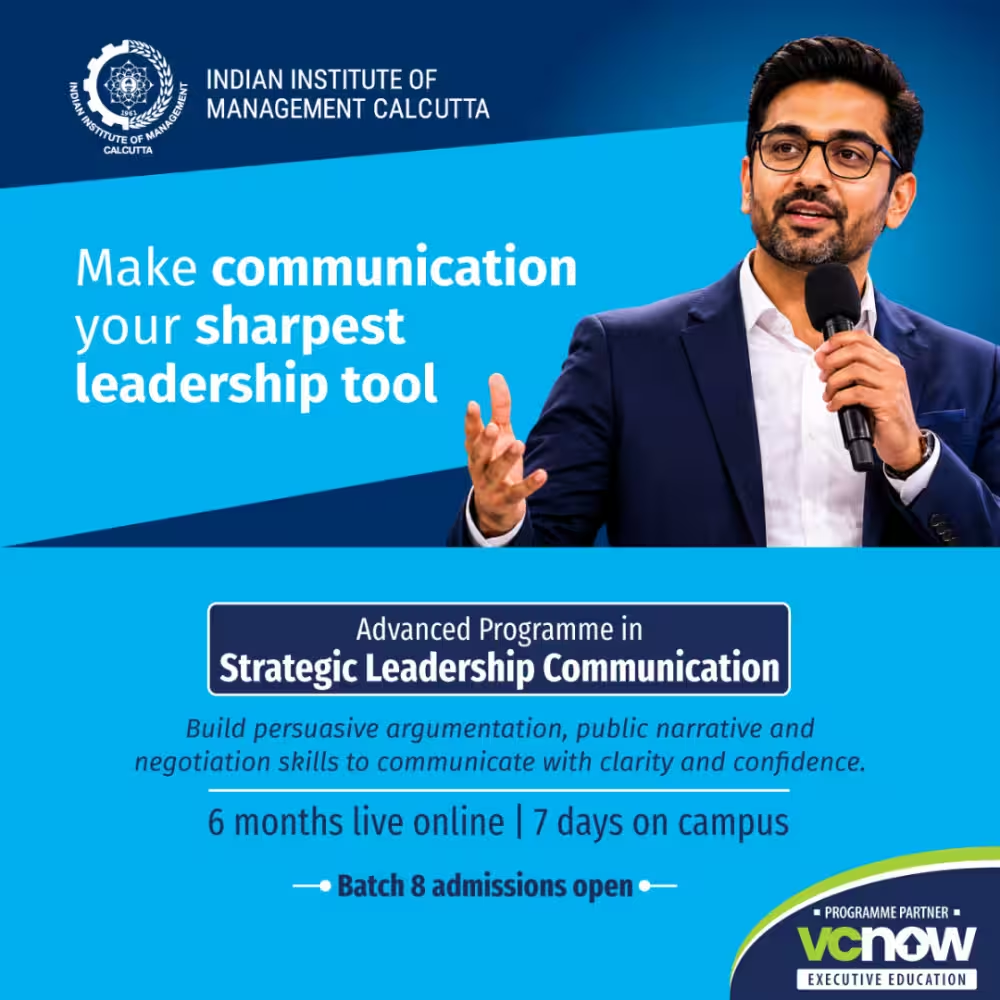
Advanced Programme in Strategic Leadership Communication (Batch 8)

Leaders who drive impact share one trait: their communication carries real weight. This programme goes beyond common ideas of communication training, drawing on tools and practices from multiple disciplines — from digital communication and data storytelling to crafting arguments, shaping public narratives, and applying negotiation techniques — all aimed at building a stronger executive presence and a clearer communication strategy across cultures.

  • Duration: 6 months

  • Mode: Live online + 7 days of campus learning at IIM Calcutta

  • Eligibility: Working professionals with 5+ years of work experience

  • For admissions in batch 8: visit the website

Executive Programme in Business and Corporate Laws (Batch 8)

Legal and regulatory frameworks have long been treated mainly as a compliance checkbox, with their potential as a strategic tool left largely unused. Built on a foundation of legal knowledge, this programme covers setting up business operations, raising capital, JV transactions, M&A, external commercial borrowings, private equity and venture capital, capital and forex market regulation, IPR strategy, and risk management in foreign investment, global trade, and international dispute resolution — aimed at using legal fluency for competitive advantage rather than just risk avoidance.

  • Duration: 9 months

  • Mode: Live online + 7 days of campus learning at IIM Calcutta

  • Eligibility: Working professionals with 2+ years of work experience

  • To express interest in batch 8: visit the website

The future of leadership won't belong to those who can predict what's next, but to those who adapt fastest. As AI, geopolitics and regulation reshape business at unprecedented speed, strategic thinking, clear communication, and sound governance are becoming core leadership skills — and by helping professionals keep sharpening all three, IIM Calcutta is aiming to help leaders turn uncertainty into opportunity rather than just manage it.

Disclaimer: This article has been produced on behalf of VCnow (Unified Collaboration Services) by Times Internet's Spotlight team.

Get the latest Education News and Live updates. Download the TOI app.